

Deep Work vs Shallow Work: The Complete Guide to Focused Success
Deep work isn't just productivity—it's your competitive advantage in a distracted world. Discover Cal Newport's four rules and how to protect your capacity for cognitively demanding work.


You’ve had that day. Meetings, emails, Slack messages — constant motion. But when you stop and ask what you actually accomplished, the answer is thin.
Nothing important moved forward.
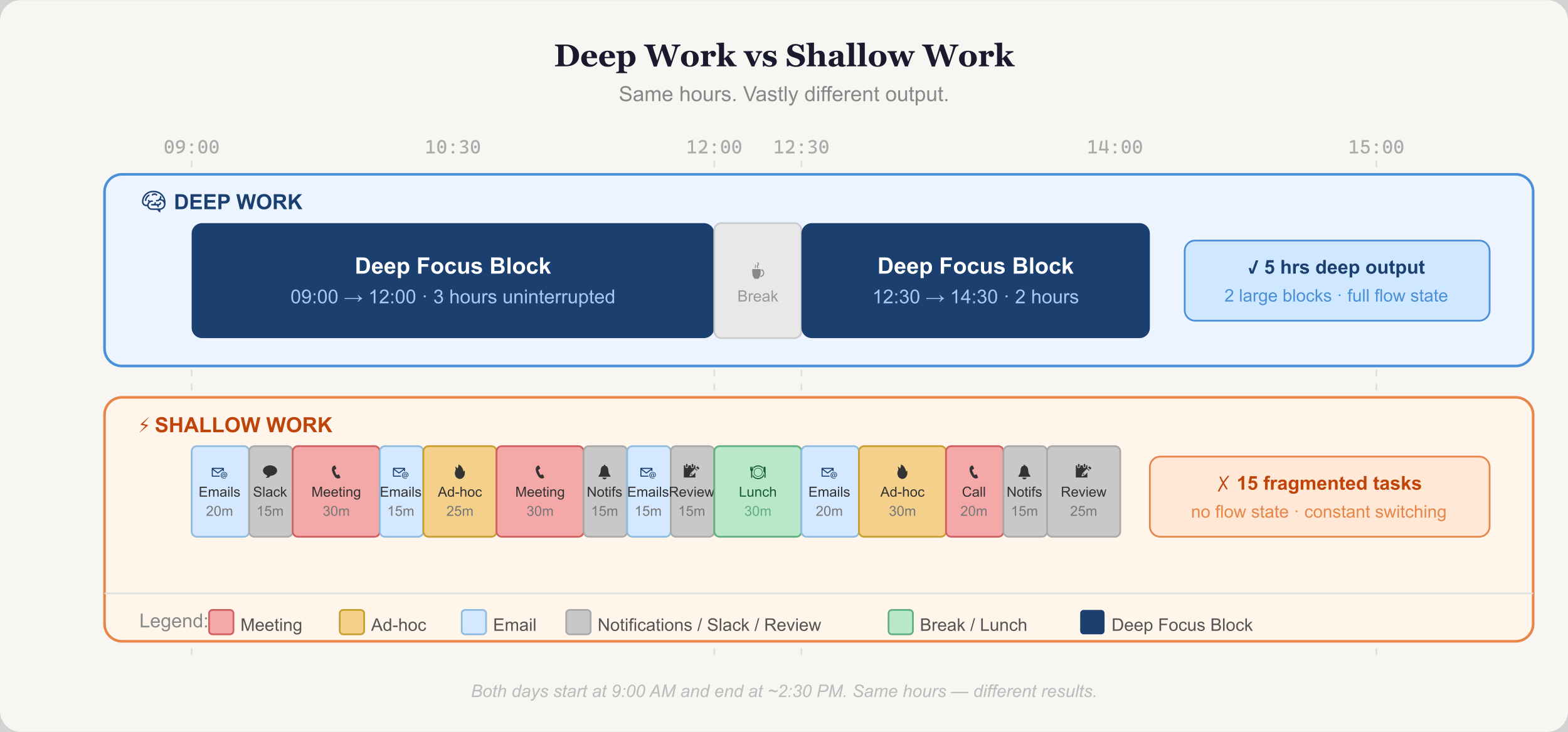
Cal Newport calls this shallow work — logistical tasks done while distracted that create little real value. The opposite is deep work: focused, cognitively demanding effort that produces results that matter.
The distinction isn’t just about productivity. It’s about what you’re capable of producing when you’re fully present.
What Is Deep Work?
Cal Newport defines deep work as sustained, distraction-free focus on cognitively demanding tasks — the state where your brain performs at its ceiling.
Think of a writer lost in a manuscript, a developer debugging complex code, a strategist mapping out a new direction. These tasks can’t be done while checking notifications. They demand everything you have — and they produce work that’s hard to replicate.
Neurologically, deep focus strengthens neural pathways. You literally rewire yourself. This only happens without distraction.
Deep work is also a form of flow state — that zone where challenge and skill meet. It’s intrinsically rewarding. As Newport puts it: “A deep life is a good life.”
What Is Shallow Work?
Shallow work is logistical — tasks you can do while distracted that produce little new value:
Answering routine emails
Attending agenda-less meetings
Checking Slack or Teams
Data entry and admin tasks
Scrolling social media
Some shallow work is unavoidable. The problem is most professionals spend the majority of their time there.
Knowledge workers spend about 60% of their time on coordination tasks. The average employee is interrupted 31.6 times per day, and it takes 15–20 minutes to rebuild focus after each one. Multitasking reduces productivity by up to 40%. Despite working 47.6 hours a week, employees average just 11.2 hours of productive output.
The shallows are expensive.
The Deep Work Gap
Newport asks leaders: how much deep work should you do each day? They say about 4 hours. How much do they actually do? Less than 1 — often squeezed into evenings when interruptions stop.
Many report doing zero.
This gap is massive untapped value. Some companies are already closing it:
Dropbox runs “core hours” from 9am–1pm PST — the only window for meetings. Everything else is protected focus time.
Slack asked teams not to schedule more than 4 hours of meetings per day. The rest becomes deep work by default.
Asana held “Meeting Doomsday” — cancel every recurring meeting, then only restore the ones that are genuinely worth it. On average, people recovered 11 hours per month — 17 days per year.
Why Deep Work Matters
It raises the quality of your output. Focus lets you learn hard things fast and produce work at an elite level — skills that make you genuinely valuable.
It’s increasingly rare. When 60% of knowledge worker time goes to coordination, teams that protect focus have a real edge. They produce more by doing less of the wrong things.
It feels good. Research shows that what you pay attention to shapes how you perceive the world. Spend time in deep work, and your days feel meaningful.
In an economy driven by information and innovation, focused work is the ultimate competitive advantage. Automation takes the shallow tasks. The humans who remain will be the ones who can learn fast and produce at depth.
The Four Rules for Deep Work
Newport’s solution is four rules for mastering focus.
Rule 1: Work Deeply
Deep work doesn’t happen by accident. You have to design for it.
Build routines that train your mind to concentrate. Block time, remove distractions, use a dedicated workspace. Treat it like athletic training — a discipline, not a mood.
Practical tips:
Set firm start and stop times
Silence all notifications
Work in 60–90 minute blocks
Use a space that signals “it’s time to focus”
Rule 2: Embrace Boredom
Every time you reach for your phone because you’re bored, you train your brain to expect constant stimulation. That erodes your focus capacity.
Newport recommends retraining your brain by sitting with boredom. Try “productive meditation” — focusing on a single problem during a walk or another low-intensity task. It builds mental endurance.
Rule 3: Quit Social Media
This is the most provocative rule. Newport doesn’t say delete everything — but be selective. If a tool doesn’t serve a clear, high-value purpose, cut it or strictly limit it.
For most people, social platforms fragment attention and make sustained concentration harder. You don’t have to disappear, but consider removing apps from your phone, batching your use, or doing a 30-day digital declutter to see what you actually miss.
Rule 4: Drain the Shallows
Schedule every minute of your workday — not to be rigid, but to see honestly where your time goes.
Ask whether each meeting is necessary. Can it be an email?
Batch email responses once or twice a day.
Identify your sharpest hours and guard them for deep work.
Learn to say no to requests that pull you away from what matters.
Reclaiming the shallows creates space for work that lasts.
How IdealWeek Covers This
Most productivity tools give you a blank canvas. IdealWeek takes a different approach — it builds the bridge between your goals and your daily schedule, and it’s designed to protect your capacity for deep work.
Focus & Notifications — the burning candle focus mode creates a distraction-free environment. Smart reminders and Pomodoro timers protect sessions from the interruptions that fracture attention.
Insights — the time allocation breakdown shows exactly how much time went to OKR work versus ad-hoc tasks. You can see your shallow work patterns clearly, and watch cognitive rewiring over time through progress tracking.
Time Management & Execution — the timeline-based daily planner with exact start and end times ensures deep work is scheduled and defended, not just hoped for. Time blocking with recurring schedules mirrors company-level policies like Dropbox’s core hours.
The Execution Planner — enforces the structure Newport describes: scheduling every minute, batching shallow work, identifying deep work windows.
The difference from general-purpose tools like Notion or Todoist is structural. IdealWeek forces the right questions: What do you actually want? Why does it matter? What measurable progress proves you’re moving?
And it protects the time you need to move.
Key Takeaways
Deep work is distraction-free concentration on cognitively demanding tasks; shallow work is logistical tasks done while distracted
Attention residue from task-switching takes up to 20 minutes to recover — interruptions cost far more than they appear
Knowledge workers spend 60% of time on coordination; only 53.5% of planned tasks get completed weekly
The deep work gap: leaders say they should do 4 hours daily but actually spend less than 1
Cal Newport’s four rules: work deeply, embrace boredom, quit social media, drain the shallows
Four deep work philosophies: Rhythmic (daily habit), Journalistic (flexible), Monastic (eliminate shallow), Bimodal (divide time)
Deep focus literally rewires your brain by strengthening neural pathways
Companies like Dropbox, Slack, and Asana protect deep work through core hours, meeting limits, and no-meeting days
A deep life is a good life — flow state is intrinsically rewarding and creates meaning
Most people can sustain only 4–5 hours of intense deep work per day; rest matters